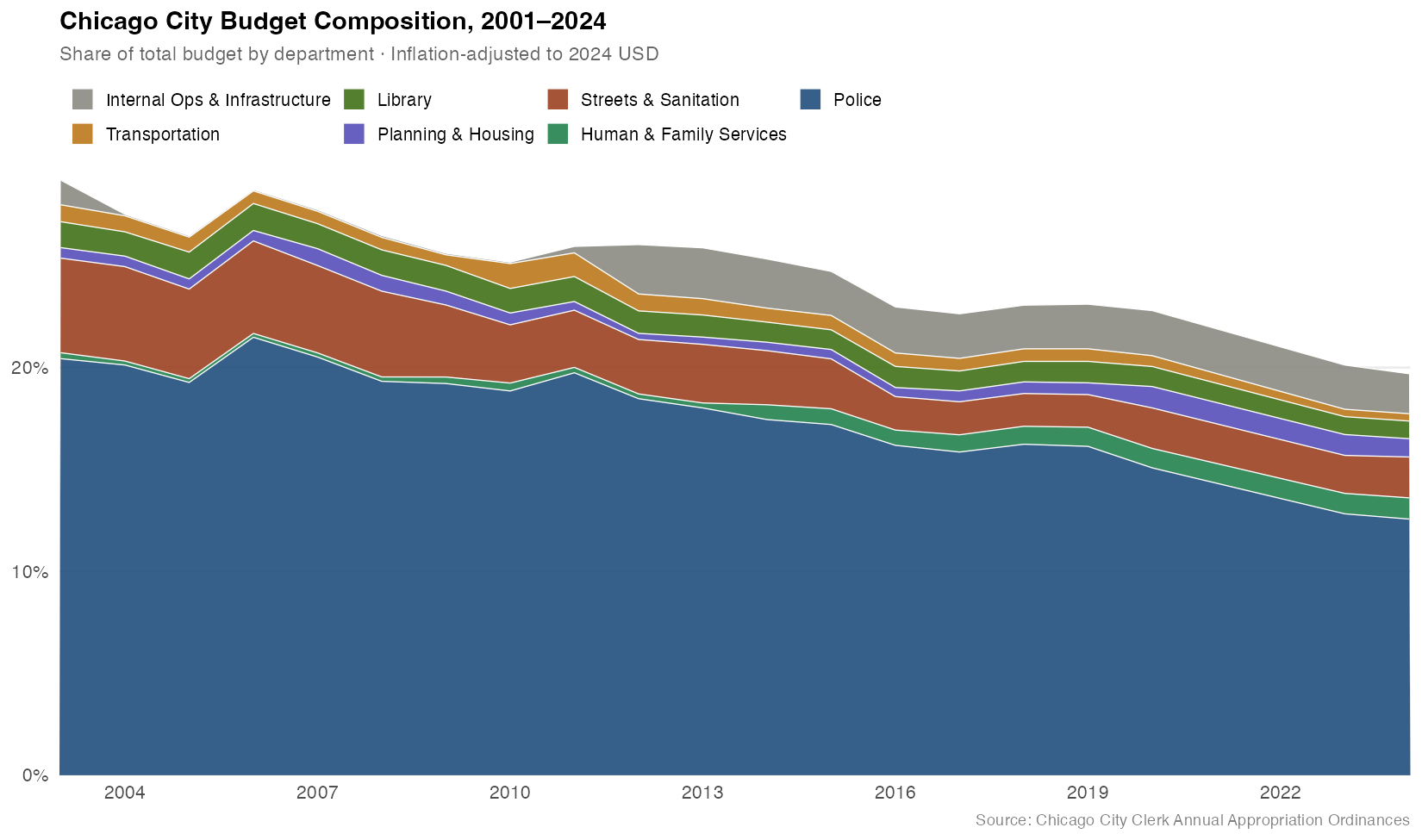
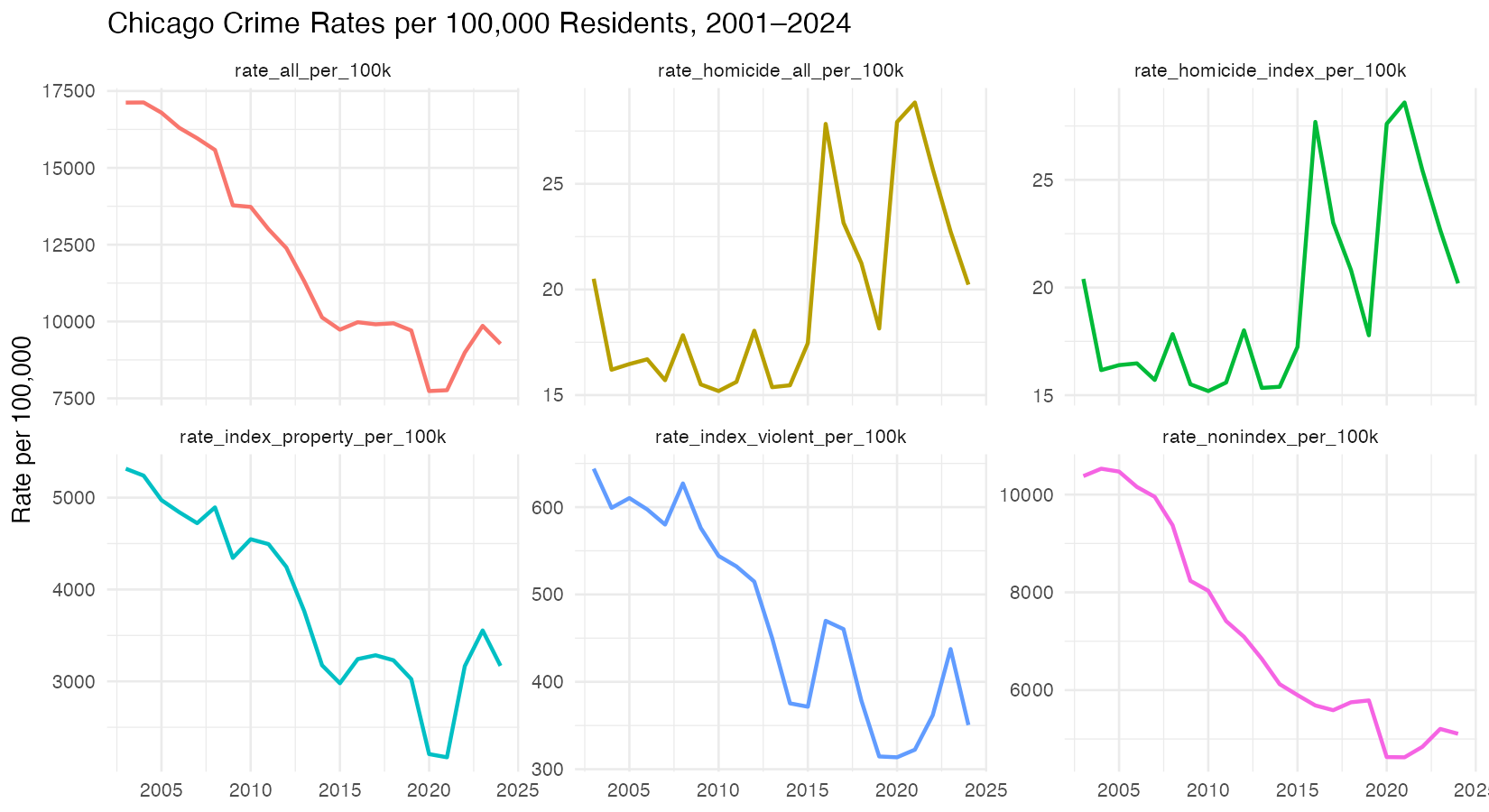
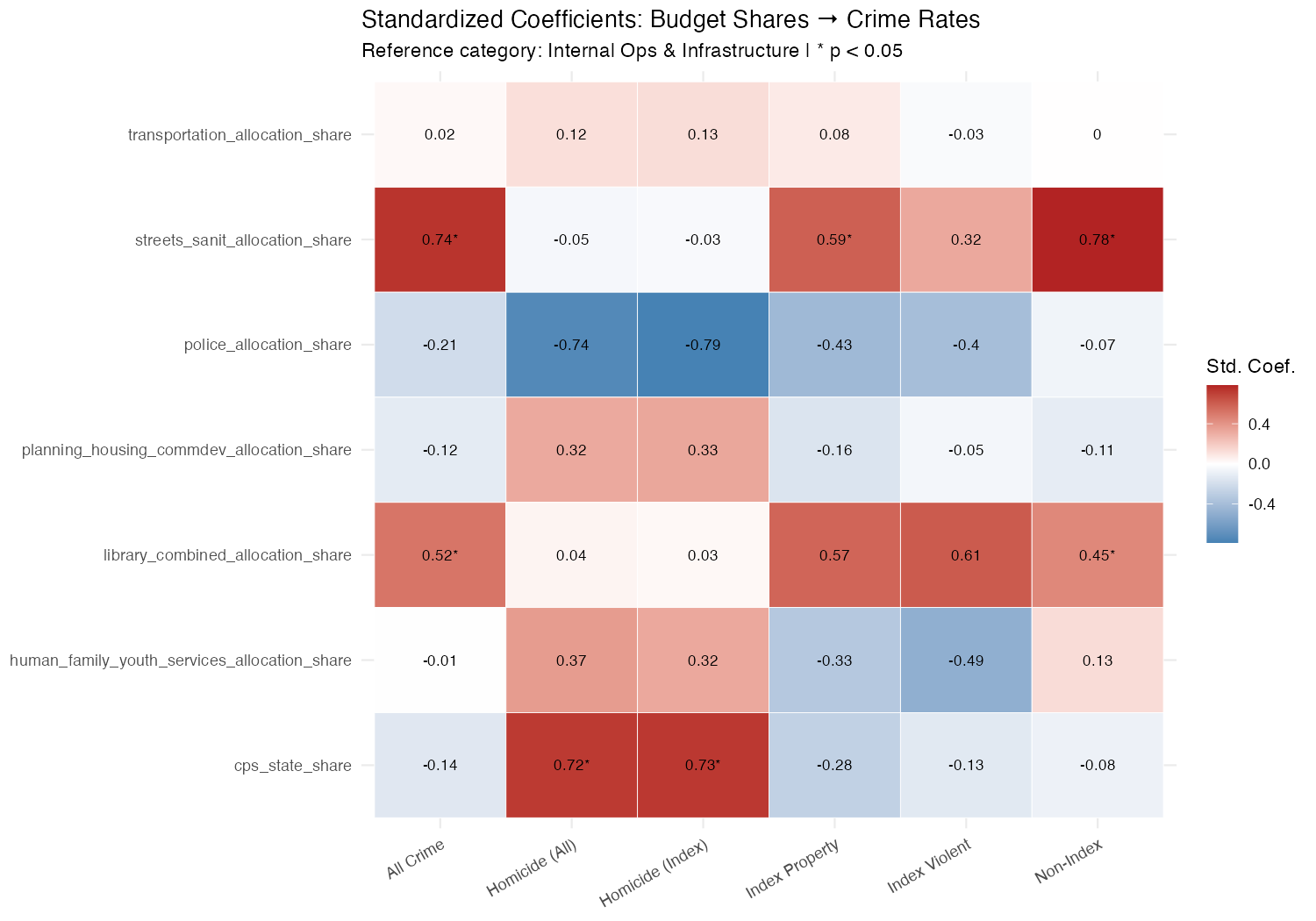
Each category was chosen because it represents either a direct theory about crime prevention or a commonly cited alternative to policing. Here's what each includes and why it was included.
The largest single line item in Chicago's budget. Covers sworn officers, civilian staff, equipment, and operations for the Chicago Police Department.
The central variable in the analysis. If increased policing deters crime, higher police spending share should correlate with lower crime rates.
A consolidated category combining the Department of Human Services, Department of Family and Support Services, and child and youth services programs. Covers social safety net programs, youth intervention, domestic violence services, and more.
A direct test of the social investment hypothesis. If investing in support services addresses root causes of crime, higher spending here should associate with lower crime rates.
Combines the Department of Housing, Department of Planning and Development, and community development allocations. Covers affordable housing programs, neighborhood investment, and economic development initiatives.
Housing instability and concentrated poverty are well-established correlates of crime. Spending here tests whether investment in place-based stability associates with lower crime.
Covers library operations, programming, and facilities across Chicago's branch system. Libraries are often cited as community anchors that provide after-school programming, job resources, and safe public spaces.
Research has linked library access to reductions in youth crime. Included as a test of whether publicly accessible community infrastructure associates with safety outcomes.
Covers street cleaning, waste collection, alley maintenance, and rodent abatement. Often cited in broken windows theory, which argues that signs of physical disorder signal low social control and invite crime.
Included to test whether investment in the physical maintenance of neighborhoods associates with lower crime, separate from direct social or policing interventions.
Covers the Chicago Department of Transportation's infrastructure work including street lighting, traffic signals, sidewalks, and road maintenance. Street lighting in particular has an established evidence base in crime prevention.
Included as a test of whether physical infrastructure investment, especially lighting and accessible streets, independently associates with crime outcomes.
A consolidated category covering fleet and facilities management, asset and information services, architecture, construction, energy management, and environmental sustainability. Represents the city's internal administrative and operational infrastructure.
Included as the reference category in regression models. Spending here represents operational overhead rather than direct service delivery, providing a neutral baseline for comparison.
The share of Chicago Public Schools' total revenue that comes from state sources. Unlike city budget categories, this captures school funding from outside Chicago's direct budget control. Includes state education aid and formula funding.
Education investment is one of the strongest long-term correlates of reduced crime. State funding share was used (rather than total CPS spending) to isolate funding that varies independently of local budget decisions.